
Your key fob used to lock the car from several metres away. Now you have to stand beside the door before anything happens.
A key fob that only works close to the car often has a weak battery. However, damaged battery contacts, internal key faults, radio interference, or a vehicle receiver problem can cause the same symptom.
The easiest first check is to compare your main key with a spare. If the spare works normally from farther away, the problem is more likely inside the main fob.
Why Has My Key Fob Range Become Shorter?
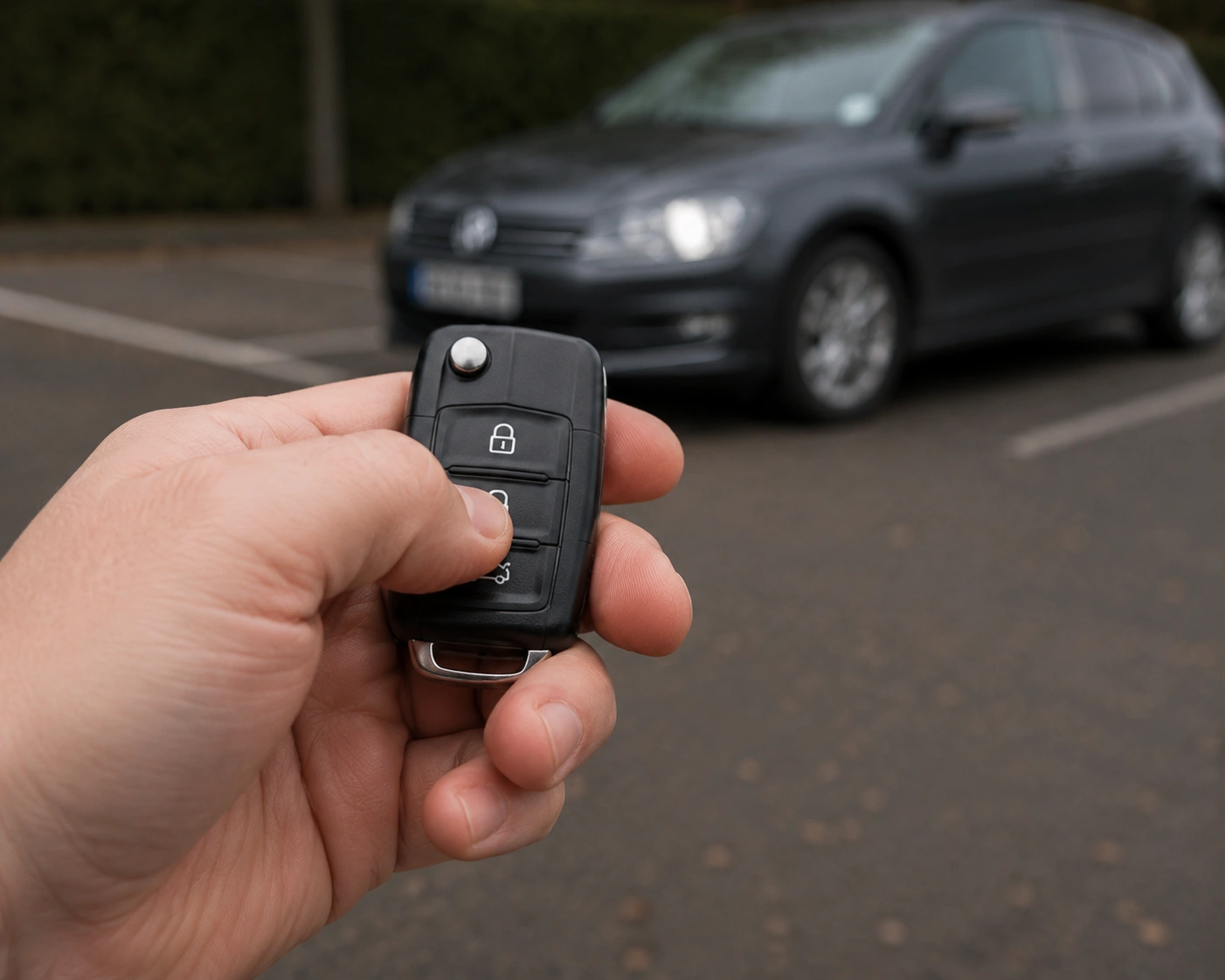
Reduced key fob range means the remote signal is either weaker than normal or the car is struggling to receive it.
Possible causes include:
- Weak key fob battery
- Loose or dirty battery contacts
- Internal circuit-board damage
- Key fob antenna damage
- Radio frequency interference
- Vehicle receiver or aerial faults
- Weak vehicle battery
- Lost or poor synchronisation
A shorter range does not automatically mean you need a new key.
A professional car key repair may be possible when the problem comes from contacts, casing damage, buttons, or internal electronics.
Quick Key Fob Range Symptom Checker
| What you notice | Possible cause |
| Remote only works beside the car | Weak battery, contacts or signal problem |
| Range became worse slowly | Battery or internal wear |
| Range dropped after the key was dropped | Circuit board, antenna or solder damage |
| Range dropped after water exposure | Corrosion or circuit damage |
| Spare key works normally | Main key fault more likely |
| Both keys have poor range | Vehicle receiver or interference should be checked |
| Remote works better in another location | Radio interference more likely |
| New battery made no difference | Contacts, electronics or vehicle fault |
| Range changes when the casing is squeezed | Contact or casing problem |
| Key starts the car but remote range is poor | Remote section may have a separate fault |
These clues help narrow the problem, but they do not replace proper testing.
What Is Normal Key Fob Range?
There is no single normal distance for every car.
Remote range depends on:
- Vehicle design
- Key type
- Battery condition
- Receiver position
- Surrounding buildings
- Radio interference
- Weather and environment
- Where you stand around the vehicle
A standard remote key and a proximity smart key may also behave differently.
The important clue is change.
If your key always worked from a certain distance but now only works beside the car, something has probably changed.
Do not compare your vehicle with another model and assume the same range should apply.
What Causes a Weak Key Fob Signal?
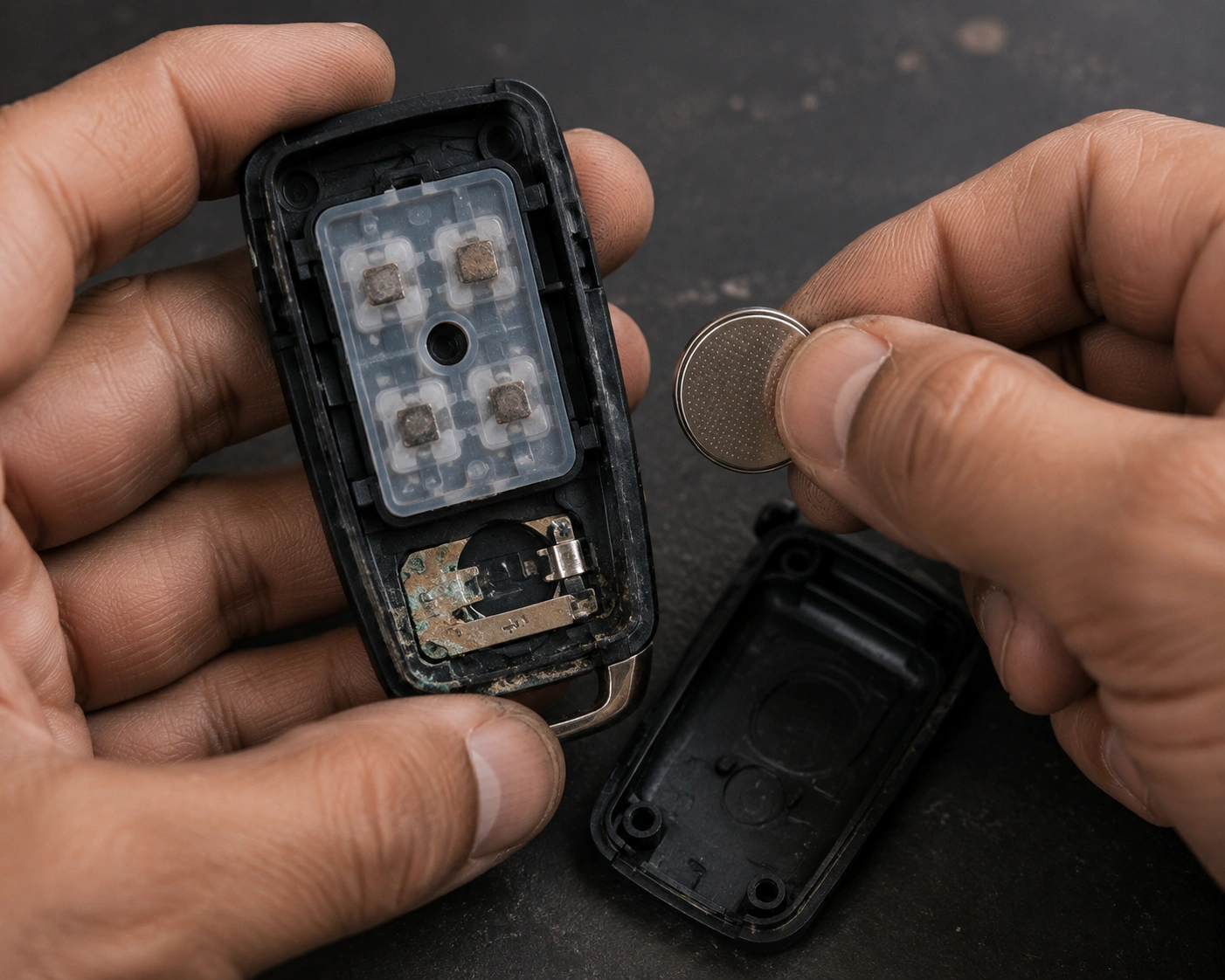
Weak Key Fob Battery
A weak battery is one of the most common causes of reduced range.
As battery performance drops, the remote may struggle to send a strong enough signal over the distance it handled before.
Common signs include:
- You need to stand closer
- The buttons work intermittently
- Several presses are needed
- Keyless entry becomes unreliable
- A low key battery warning appears
Car Keys 24 already explains that shorter remote range can be an early sign of a low battery.
This article will not repeat the replacement process. If battery weakness looks likely, follow the existing guide on changing a car key battery.
Use the exact battery type specified for your key. Similar-looking coin cells can have different sizes and capacities.
Poor Battery Contacts
A healthy battery cannot power the fob properly if the contacts are loose, bent, dirty, or corroded.
The key may:
- Work when squeezed
- Work at certain angles
- Lose range suddenly
- Operate intermittently
- Stop responding after being dropped
Car Keys 24 notes that worn or loose contacts can create intermittent key problems even after a new battery is fitted.
The casing can also affect contact pressure.
If the battery moves inside the key or the shell no longer closes correctly, the electrical connection may become unreliable.
Internal Key Fob Damage
A car key goes through a lot of daily wear.
It may be dropped onto hard floors, crushed in bags, exposed to moisture, or pressed hundreds of times.
Impact can damage:
- Circuit-board tracks
- Solder joints
- Battery contacts
- Small electronic components
- Remote transmission parts
A weak car key signal may appear before the remote stops completely.
If the problem started immediately after a drop, tell the technician. That history is useful during diagnosis.
Key Fob Antenna Damage
The remote needs an antenna to transmit its radio signal.
Depending on the design, the antenna may form part of the circuit board rather than appearing as a separate visible wire.
Damage to the board or nearby components can affect transmission strength.
Possible signs include:
- Battery tests correctly
- Buttons respond normally
- Remote still sends a signal
- Range remains much shorter than before
This type of problem usually needs electronic testing.
Do not try to modify the antenna yourself. The remote is designed to operate on specific radio frequencies and specifications.
Radio Frequency Interference
Sometimes the key and vehicle are both healthy.
Other radio signals nearby can make communication harder.
Possible sources include:
- Wireless equipment
- Radio transmitters
- Electronic installations
- Some chargers or accessories
- High levels of local radio activity
A useful clue is location.
If the remote works poorly in one car park but returns to normal somewhere else, interference becomes more likely.
Car Keys 24 also lists radio signal interference as a possible cause when a remote does not respond normally.
Do not assume every nearby phone or electronic device is causing the problem. Interference needs to match the pattern you are seeing.
Vehicle Receiver or Aerial Fault
Your car contains equipment that receives the remote signal.
If the receiver or its aerial develops a fault, even a healthy key may only work from a short distance.
This becomes more likely when:
- Both keys show similar poor range
- Fresh batteries do not help
- The problem occurs in different locations
- Both remotes became weaker around the same time
The fault may involve the receiver, aerial, wiring, or another part of the central locking system.
Car Keys 24 includes faulty receivers and aerial faults among possible vehicle-side causes of key problems.
Weak Vehicle Battery
The main vehicle battery can also affect electrical systems.
A weak car battery is more worth considering when poor remote operation appears alongside other symptoms, such as:
- Slow engine cranking
- Dim lights
- Electrical warnings
- Other central locking problems
Do not assume a slightly reduced remote range alone proves the vehicle battery is weak.
If everything else in the car works normally, check the fob and receiver first.
Synchronisation Problems
Some vehicle and key systems can lose or require renewed synchronisation.
However, lost synchronisation more often causes complete or inconsistent remote failure than a simple gradual loss of range.
It becomes more relevant when:
- The key battery was recently removed
- The fob suddenly stopped communicating
- The remote sends a signal but the car does not respond
- The engine still recognises the key
- Other physical key components test correctly
There is no universal reset procedure.
Car Keys 24 advises against using random online button or ignition sequences because the correct process depends on the vehicle and key system.
Try This Two-Key Diagnostic Test
If you have a spare key, you can perform a simple comparison without opening either fob.
Step 1: Choose an Open Location
Park somewhere away from obvious electrical equipment or large buildings when possible.
Keep the vehicle in the same position throughout the test.
Step 2: Test the Main Fob
Stand a short distance from the vehicle.
Press the lock or unlock button once.
Move farther away in small steps until the remote stops responding.
Remember roughly where that happens.
Step 3: Test the Spare Fob
Return to the same positions and repeat the test with your spare key.
Use the same button and face the same side of the vehicle.
Step 4: Compare the Results
The difference can provide a useful clue.
| Test result | What it suggests |
| Main fob poor, spare normal | Main fob fault more likely |
| Both fobs poor in one location | Interference may be involved |
| Both fobs poor everywhere | Vehicle receiver should be checked |
| Main improves with correct new battery | Battery was likely contributing |
| Main remains poor after battery change | Contacts, board or antenna need checking |
This is not a laboratory range test.
You are simply comparing two keys under the same conditions.
What If You Only Have One Key?
You can still look for patterns.
Try the remote:
- At home
- At work
- In an open car park
- From different sides of the car
- At different distances
If the remote only works close to the car everywhere, the fob or receiver needs closer inspection.
If the problem only occurs in one location, interference becomes more likely.
Do not keep buying batteries if a correct fresh battery makes no difference.
How Can You Tell Whether the Fault Is the Key or the Car?
The pattern often gives the best clue.
The Spare Key Works Normally
This strongly points towards the main fob.
Possible causes include:
- Weak battery
- Poor contacts
- Internal damage
- Antenna fault
- Moisture damage
Both Keys Have Poor Range
The vehicle side becomes more important.
Possible causes include:
- Receiver fault
- Aerial problem
- Vehicle electrical issue
- Radio interference
There is one important exception.
If both fobs are old and have not had their batteries checked for a long time, both batteries could also be weak.
The Problem Changes With Location
This points more towards interference.
A damaged fob tends to remain damaged wherever you use it.
The Problem Started After Damage
If the range dropped after the key was dropped, crushed, or soaked, inspect the key first.
For moisture-related faults, see our guide to water-damaged key fob repair.
Safe Checks You Can Make Yourself
You do not need to dismantle the electronics.
Start with simple observations.
Test Every Button
Check lock, unlock, and boot release separately.
If only one button fails, you may have a button fault rather than a range problem.
Read our guide to car key button faults when one physical button behaves differently.
Try Another Location
Move the vehicle or test the key elsewhere.
A large improvement can point towards local interference.
Try the Spare Key
This remains one of the most useful checks.
It helps separate one faulty fob from a vehicle-side issue.
Check for Recent Damage
Think about whether the key has recently:
- Been dropped
- Got wet
- Been crushed
- Had its casing changed
- Had its battery changed
Tell the technician what happened before the range changed.
Check the Vehicle for Other Symptoms
Notice whether the car has:
- Central locking problems
- Electrical warnings
- Starting trouble
- Battery warnings
- Problems detecting both keys
These symptoms can help direct the diagnosis.
How Does a Technician Diagnose Reduced Key Fob Range?
Professional diagnosis should test both the key and the vehicle.
1. Check the Symptoms
The technician asks when the range changed and whether another key works.
This prevents unnecessary parts replacement.
2. Test the Fob Battery
Battery condition can be checked without assuming it is the only cause.
A correct battery that performs normally means the diagnosis should move on.
3. Check Battery Contacts
Loose, bent, dirty, or corroded contacts can reduce reliable power to the remote electronics.
4. Inspect the Circuit Board
The technician checks for:
- Impact damage
- Corrosion
- Cracked solder joints
- Damaged tracks
- Loose components
This is especially important after water or impact damage.
5. Test Remote Transmission
Specialist equipment can help confirm whether the fob is transmitting.
This separates a weak or dead remote from a vehicle that simply is not receiving the signal correctly.
6. Compare With the Spare
When possible, both keys can be tested under the same conditions.
A clear difference provides useful evidence.
7. Check the Vehicle Receiver
If both keys transmit correctly but range remains poor, the receiver, aerial, wiring, or related vehicle system may need diagnosis.
The aim is to locate the fault before recommending a replacement key.
Can Reduced Key Fob Range Be Repaired?
Yes, depending on the cause.
Repair may be possible when the problem involves:
- Battery contacts
- Damaged casing
- Solder joints
- Circuit-board faults
- Moisture damage
- Internal components
- Synchronisation
Car Keys 24 provides repair services for car key electronics and related fob faults.
The correct repair depends on what testing finds.
A weak signal does not automatically require a complete new key.
When Might the Key Fob Need Replacing?
Replacement may be more suitable when:
- The circuit board is badly damaged
- The transmission section cannot be repaired
- Corrosion is widespread
- Previous repairs keep failing
- Several key functions have failed
- The key is no longer reliably compatible with the vehicle
- Repair is not economical compared with replacement
A technician should explain why replacement is needed.
If a used key is being considered as an alternative, compatibility must be checked carefully. Our guide to used key fob programming explains why a similar-looking used remote may not automatically work with another vehicle.
Frequently Asked Questions
Why does my key fob only work when I stand beside the car?
A weak battery is a common cause. Poor contacts, internal damage, interference, or a vehicle receiver fault can also reduce the working range.
Does a weak key fob battery reduce range?
Yes. Reduced range can be an early sign that the battery is becoming weak. However, other faults can produce the same symptom.
Why did a new battery not improve my key fob range?
The battery may not be the cause. Check for poor contacts, circuit-board damage, interference, antenna problems, synchronisation, or a vehicle receiver fault.
How can I tell if the car receiver is faulty?
Try another working fob. If both remotes have similarly poor range in different locations, the vehicle receiver or aerial becomes more likely.
Can radio interference reduce key fob range?
Yes. Nearby radio signals can sometimes interfere with remote communication. A key that works normally elsewhere but poorly in one location may be affected by interference.
Can dropping a key fob reduce its signal range?
Yes. Impact can damage solder connections, contacts, the circuit board, or parts involved in transmitting the remote signal.
Can water damage make a key fob signal weaker?
Yes. Moisture and corrosion can affect battery contacts and electronic components. The key should be inspected if the range dropped after water exposure.
Why does my spare key work farther away?
If the spare works normally under the same conditions, the main fob probably has a local battery, contact, circuit-board, or signal fault.
Does a key fob need reprogramming when its range becomes weak?
Usually not because of range alone. Synchronisation or programming should only be considered when testing suggests the key and vehicle are no longer communicating correctly.
Can an auto locksmith test key fob range problems?
Yes. An auto locksmith can check the battery, contacts, electronics, remote transmission, spare key, and vehicle response before recommending repair or replacement.
Get Your Key Fob and Vehicle Receiver Checked
If your key only works beside the vehicle, you do not need to guess whether the battery, fob, or car is causing it.
Contact Car Keys 24 with:
- Vehicle registration
- Make and model
- Year
- Postcode
- Approximate working range
- Whether the range changed suddenly
- Whether another key works normally
- Whether the fob was dropped or got wet
A technician can check the fob and vehicle response before recommending the correct repair.
Call Car Keys 24 on 07731 505 060.


