
A spare car key is useful only when it is both secure and available when you need it.
At home, keep your spare inside the property, out of sight, and away from doors, windows, letterboxes, and the vehicle itself. A locked cupboard or secure safe can provide extra protection.
If your spare is a keyless fob, place it inside a working signal-blocking pouch when it is not being used.
Never hide a spare inside the vehicle or in obvious outdoor places such as flowerpots, fake rocks, or under a doormat.
Where Is the Safest Place for a Spare Car Key?
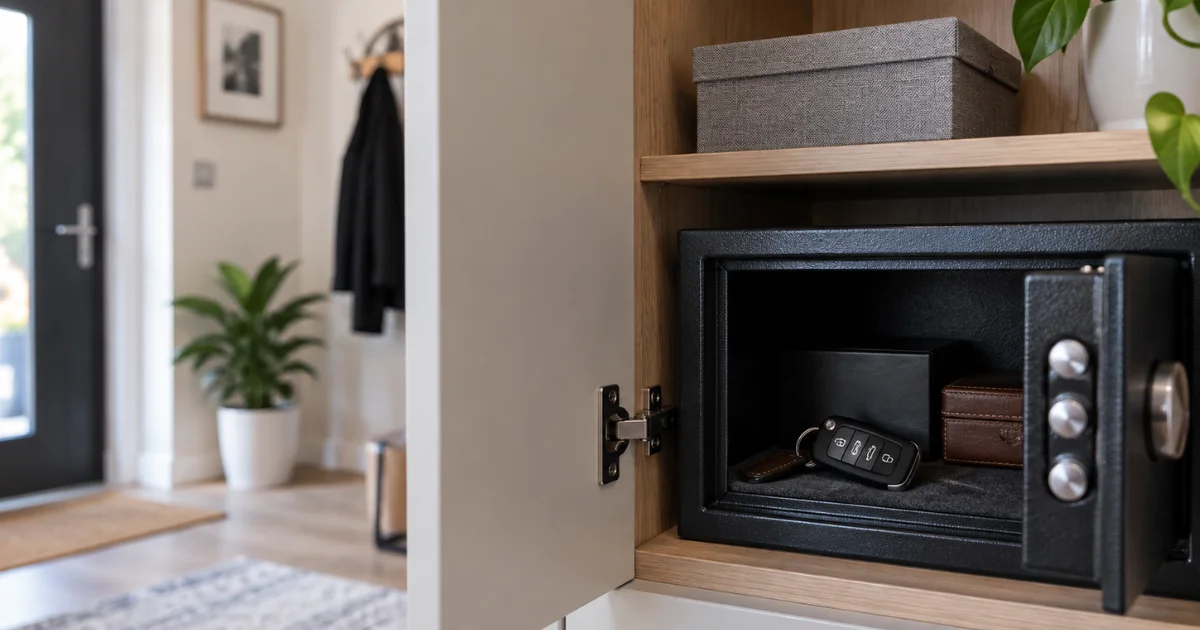
For most homes, a good spare-key location has four features.
It should be:
- Inside the home
- Away from doors and windows
- Out of sight
- Difficult for an intruder to access quickly
For extra protection, use a locked cupboard, cabinet, or secure safe.
Recent UK police advice tells drivers to keep car keys and fobs out of sight and away from doors, windows, and letterboxes. Avon and Somerset Police also recommends locked cupboards, cabinets, key safes, or lock boxes rather than convenient hiding places.
If you do not currently have a backup, Car Keys 24 provides a mobile spare car key service.
Safe, Risky and Avoid Spare-Key Storage Locations
| Storage location | Our view | Why |
| Locked safe inside the home | Good | Harder for an intruder to access quickly |
| Locked internal cupboard | Good | Keeps keys hidden and away from entry points |
| Faraday pouch inside secure storage | Good for keyless fobs | Adds protection against relay attacks |
| With a trusted person | Can be suitable | Keeps the spare separate from your main key |
| Bedroom drawer away from windows | Reasonable | Better than hallway or entrance storage |
| Hallway table | Risky | Easy to see or reach during burglary |
| Hook beside the front door | Risky | Close to doors and letterboxes |
| Unlocked kitchen drawer near entrance | Risky | Easy to access during a break-in |
| External key box | Usually avoid for car keys | May become an obvious target |
| Flowerpot or fake rock | Avoid | Common hiding places |
| Under a doormat | Avoid | Easily checked by thieves |
| Glove box | Avoid | Gives the spare away with the vehicle |
| Boot or centre console | Avoid | The key remains inside the car |
No storage place makes theft impossible.
The aim is to remove easy opportunities.
Where Should You Keep a Spare Car Key at Home?
Choose an internal location that is not part of your normal entrance route.
For example, you might use:
- A secure home safe
- A locked internal cabinet
- A locked drawer in a less obvious room
- Another secure storage area away from entrances
Avoid leaving keys where somebody looking through a window can see them.
Police.uk advises keeping both the normal key and spare well away from the vehicle.
Distance matters even more with keyless fobs because thieves may try to relay the key’s wireless signal from inside the property.
Why Should Car Keys Be Kept Away From Doors and Windows?
There are two main risks.
Physical Key Theft
A thief who enters the property may look for vehicle keys near:
- Front doors
- Hallway tables
- Coat hooks
- Kitchen surfaces
- Letterboxes
Keys stored in obvious places are quicker to find.
Merseyside Police currently advises keeping car keys and fobs out of sight and away from doors, windows, and letterboxes.
Keyless Relay Theft
Some keyless vehicles allow the car to detect the fob when it is nearby.
In a relay attack, thieves may use electronic equipment to extend communication between the key inside the home and the vehicle outside.
The exact theft method and vehicle risk vary.
However, UK police guidance consistently recommends increasing the distance between the fob and the vehicle and using signal-blocking storage.
Where Should You Store a Keyless Car Key?
A keyless spare needs both normal physical security and suitable signal protection.
A practical setup is:
- Put the fob inside a tested Faraday pouch.
- Keep that pouch away from external doors and windows.
- Store it inside a locked cupboard or safe when practical.
- Test the pouch regularly.
This creates more than one layer of protection.
Do not rely only on distance if your vehicle is known to be vulnerable to relay theft.
Police.uk currently recommends signal-blocking storage for keyless keys and specifically says to check whether the pouch is still working every few months.
What Is a Faraday Pouch?
A Faraday pouch is a signal-blocking container.
It is designed to reduce or block radio communication between the key and the vehicle.
You may also see it described as:
- Faraday bag
- Signal-blocking pouch
- Key signal blocker
- RFID-style key pouch
For keyless vehicles, the aim is to stop someone outside the property from relaying the fob’s signal to the car.
Police forces across the UK recommend Faraday pouches as one possible protection against keyless vehicle theft.
A pouch is not needed for a basic mechanical car key that sends no wireless signal.
How Do You Test a Faraday Pouch?
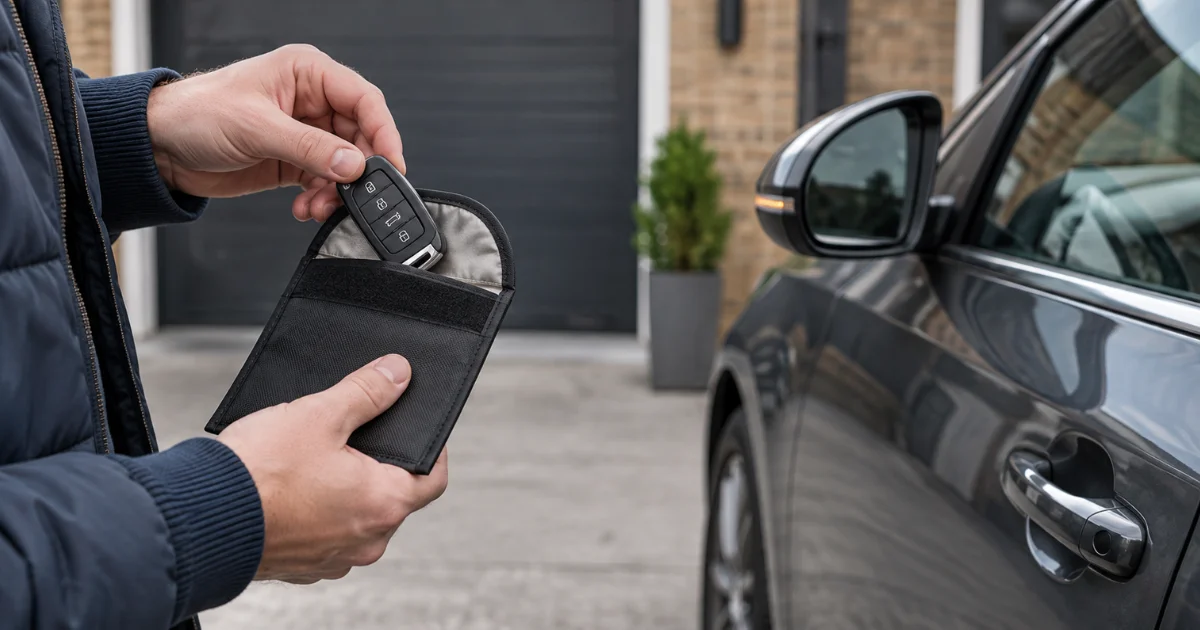
Do not assume a pouch works just because it closes.
Warwickshire Police recommends testing it with the vehicle.
A simple test is:
- Put the key fully inside the pouch.
- Close it correctly.
- Take the pouch beside the vehicle.
- Try the normal keyless-entry function.
- Check whether the vehicle detects the key.
For a push-button car, do not drive during the test.
If the vehicle can still detect the enclosed key, the pouch may not be blocking the signal properly.
Repeat the test periodically because shielding can become less effective through wear or damage. Police.uk advises checking the pouch every few months.
Can You Turn Off a Keyless Fob Instead?
Some manufacturers allow wireless functions to be disabled when the key is not in use.
Police guidance recommends checking whether your fob supports this option.
The method varies by vehicle.
Do not use a random button sequence found online.
Check:
- Vehicle handbook
- Manufacturer instructions
- Approved dealer guidance
Even when the signal can be switched off, store the physical key securely as well.
Should You Keep the Spare in a Home Safe?
A secure safe can be a sensible option.
It keeps the spare:
- Out of sight
- Away from entrance areas
- Harder to grab during a burglary
- Separate from your main key
The safe should be properly secured rather than being a small portable box that can simply be carried away.
If you have a keyless spare, use a Faraday pouch inside the safe unless you have confirmed the safe itself blocks the signal reliably.
Do not assume every metal safe is automatically a working signal blocker.
Test it with the vehicle if you plan to rely on it for that purpose.
Can You Leave a Spare Car Key With Someone You Trust?
Sometimes this is practical.
A trusted family member, friend, or neighbour may keep the spare when:
- You regularly lose access to your main key
- You travel often
- You live alone
- The person lives nearby
- You do not want both keys stored in one property
However, think about security first.
The person should:
- Store the key securely
- Know which vehicle it belongs to
- Not attach your full home address to it
- Not leave it in an obvious location
- Understand not to lend it to others
Keeping the spare elsewhere can protect you from losing both keys at once.
However, convenience should not override security.
Should You Use an Outdoor Key Safe for a Car Key?
An outdoor key safe may be useful for some household access needs, but I would avoid treating it as the default place for a car key.
A car key can provide access to an expensive vehicle.
An obvious outdoor box may:
- Be noticed
- Be attacked
- Reveal that a valuable key is stored there
- Sit very close to the vehicle
If you must use a key safe, choose a security-rated product, install it correctly, and seek suitable security advice.
For most drivers, secure indoor storage is simpler.
Where Should You Never Hide a Spare Car Key?
Avoid predictable hiding places.
Do not store it:
- Under the doormat
- Inside a flowerpot
- Inside a fake rock
- Under an outdoor bin
- In an unlocked shed
- On top of the door frame
- Inside the letterbox
- Under the car
- Behind a wheel
- Inside an external meter box
Burglars know that spare keys are often left in convenient places.
Avon and Somerset Police specifically warns against leaving spare keys under doormats or in flowerpots.
A hidden key is not necessarily a secure key.
Should You Keep a Spare Car Key Inside the Vehicle?
No.
Do not leave the only spare inside:
- Glove box
- Centre console
- Boot
- Seat pocket
- Hidden compartment
If you become locked out, the spare cannot help you.
If the vehicle is stolen or broken into, the thief may gain access to the spare as well.
A backup key should remain separate from the vehicle.
Where Should You Store a Spare When Travelling?
Travel changes the problem slightly.
You need the spare to remain secure without keeping both keys together.
Where practical:
- Carry the main and spare separately
- Do not put both on the same key ring
- Do not leave the spare inside the parked car
- Use secure hotel storage where suitable
- Avoid leaving the spare loose in luggage
- Keep vehicle documents separate from the spare
If two trusted adults are travelling together, each person may carry one key.
This reduces the chance of one lost bag taking both keys with it.
For keyless vehicles, continue using signal-blocking storage when practical.
What If Several People Use the Same Car?
A spare may be used regularly rather than only in emergencies.
Create a clear rule for where each key belongs.
For example:
- Main driver keeps one key
- Second driver keeps the other
- Both have separate secure storage
- Nobody leaves a key inside the vehicle
This reduces confusion and makes it easier to notice when a key has gone missing.
If you currently have only one key, see our guide to getting a spare car key.
Should Your Main Key and Spare Be Stored Together?
Usually, no.
Keeping both keys on the same hook or inside the same bag defeats part of the reason for having a backup.
One burglary, lost bag, or accidental misplacement could remove both.
Store the spare separately while still keeping it secure.
The locations do not need to be at opposite ends of the country.
They simply should not fail at the same time.
How Often Should You Check Your Spare Key?
A spare that has not been used for years may develop problems without you noticing.
Check it from time to time.
Confirm that it can:
- Unlock the vehicle
- Lock the vehicle
- Start the engine
- Operate remote buttons
- Support keyless entry where fitted
- Use the emergency blade where fitted
Also inspect:
- Battery condition
- Casing
- Buttons
- Blade
- Faraday pouch condition
Do not discover that the spare has failed on the day your main key disappears.
What Should You Do If a Spare Key Goes Missing?
Take the loss seriously.
First, work out whether it was:
- Misplaced at home
- Lost elsewhere
- Possibly stolen
Our guide to tracking lost car keys explains what ordinary fobs and separate tracking tags can and cannot locate.
If theft is possible, read lost and stolen key actions.
Depending on the vehicle, a technician may also need to advise whether the missing key can be removed from its electronic key list.
Frequently Asked Questions
Where is the safest place to keep a spare car key?
A secure location inside your home, away from doors, windows, and the vehicle, is usually suitable. A locked internal cabinet or secured safe provides additional protection.
Should keyless car keys be stored in a Faraday pouch?
UK police recommend signal-blocking pouches for keyless fobs to help reduce relay-theft risk. The pouch should be tested regularly.
Can I keep my spare car key in the glove box?
No. The spare should remain separate from the vehicle so it can help if you are locked out and does not become available to someone who enters the car.
Is hiding a spare key outside safe?
Obvious outdoor hiding places are not recommended. Doormats, flowerpots, fake rocks, and similar locations are easy to check.
Should my main and spare keys be kept together?
Usually not. Separate storage reduces the chance of one incident removing both usable keys.
Does a Faraday pouch work with every car key?
It is intended for keys that send wireless signals. A basic mechanical key does not need signal blocking. Always test the pouch with your own key and vehicle.
How often should I test a Faraday pouch?
Police.uk recommends checking whether the pouch is still working every few months.
Can I leave my spare with a neighbour?
You can leave it with a person you trust if they store it securely. Avoid attaching unnecessary address or vehicle information to the key.
Should I take a spare key when travelling?
A spare can be useful on longer journeys. Keep it separate from the main key and never store both together inside the vehicle.
What should I do if my spare key is stolen?
Treat it as a security issue. Consider police and insurer requirements and ask a suitable auto locksmith what electronic or physical security steps your vehicle supports.
Arrange and Store Your Spare Securely
A spare key gives you a backup only when it works and can be reached safely.
If you need another key, contact Car Keys 24 with your:
- Registration
- Make and model
- Year
- Postcode
- Current key type
Once the spare is ready, keep it away from the vehicle and obvious entry points.
For a keyless fob, use a tested signal-blocking pouch and check it regularly.
Call Car Keys 24 on 07731 505 060.


