
You press the unlock button, but nothing happens. You press harder, try again, and the car still doesn’t respond.
Car key buttons can stop working because of a weak battery, worn button pad, damaged microswitch, loose solder joint, moisture, casing damage, or lost synchronisation. Sometimes the key is fine and the fault sits with the vehicle instead.
The important part is finding the actual cause before replacing the whole key.
Why Are My Car Key Buttons Not Working?
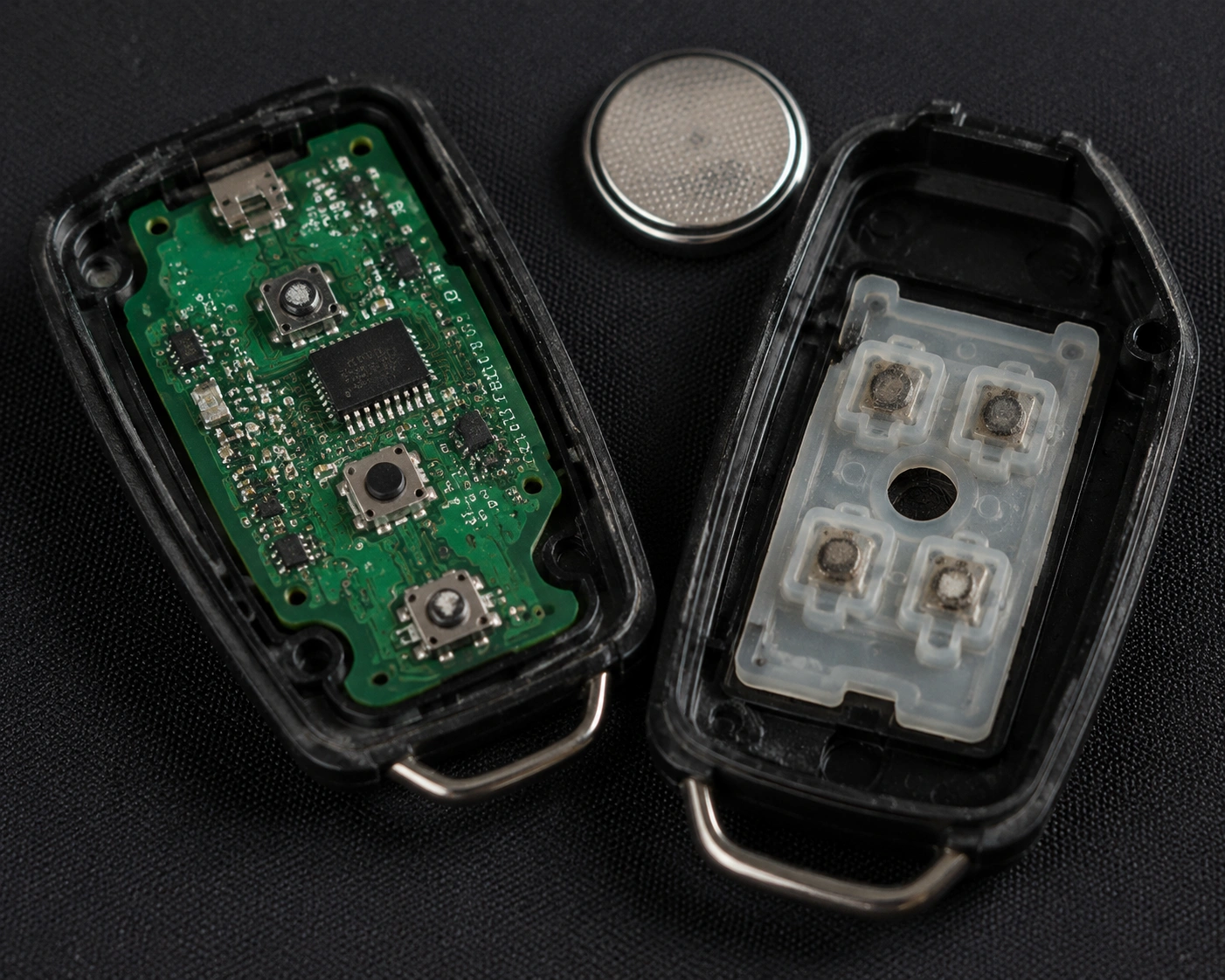
A car key fob not working properly does not always mean the electronics are dead.
The fault may be as simple as a weak battery. However, when one button works and another does not, physical button wear becomes more likely.
Common causes include:
- Weak or dead battery
- Worn rubber button pad
- Broken microswitch
- Loose solder connection
- Dirty internal contacts
- Water or corrosion damage
- Damaged key casing
- Lost remote synchronisation
- Vehicle receiver problems
RAC describes a weak battery as one of the most common reasons a key fob stops responding. Car Keys 24 also identifies damaged buttons, dead batteries, circuit-board faults, synchronisation problems, and vehicle receiver faults as possible causes.
Car Keys 24 provides professional car key repairs for damaged buttons and internal key faults.
Quick Car Key Button Symptom Checker
| What happens | Possible cause |
| None of the buttons work | Battery, contacts, synchronisation or electronics |
| One button does not work | Button pad or microswitch |
| Button feels flat or loose | Worn pad or damaged switch |
| Button only works when pressed hard | Worn pad, switch or casing pressure |
| Button works only sometimes | Battery, contact or switch fault |
| Key works when casing is squeezed | Loose battery contact or casing problem |
| Remote range has become shorter | Weak battery or signal issue |
| Spare key works normally | Fault is probably in the main key |
| Both keys stop working | Vehicle receiver or central locking fault may be involved |
| Buttons stopped after water exposure | Moisture or circuit-board damage |
| Engine starts but remote buttons fail | Remote section may have a separate fault |
This table is a starting point. Similar symptoms can have different causes, so proper testing may still be needed.
Common Causes of Car Key Button Problems
Weak or Dead Key Fob Battery
A weak battery can make the buttons slow or unreliable.
You may notice:
- The remote only works close to the car
- Several presses are needed
- All buttons become unreliable together
- The remote suddenly stops responding
Many car keys use CR-type coin cells, but there is no universal battery. Car Keys 24 lists common examples such as CR2032, CR2025, CR1632 and CR2016, while also noting that some keys use sealed rechargeable batteries.
Use the battery type specified for your key.
If a correct new battery does not solve the problem, the fault probably lies elsewhere.
Worn Rubber Button Pad
The rubber pad is the part your finger presses.
After years of use, it can become:
- Thin
- Split
- Flat
- Loose
- Torn
- Misshapen
The outer button may no longer press the switch underneath properly.
One common clue is that one button feels different from the others. You may also need to press it much harder.
A worn button pad can often be repaired without replacing the complete electronics.
Failed Car Key Microswitch
Under each button is usually a tiny switch attached to the circuit board.
This car key microswitch sends the electrical command when pressed.
A microswitch may fail because of:
- Normal wear
- Heavy pressing
- Impact damage
- Moisture
- Corrosion
- Physical breakage
If the unlock button fails but the lock and boot buttons still work, the microswitch beneath that button is worth checking.
A damaged microswitch can sometimes be replaced by a technician using specialist soldering equipment.
This is delicate circuit-board work. Trying to solder such a small component without the right equipment can damage nearby tracks or components.
Broken or Loose Solder Joint
The microswitch itself may still work, but its connection to the circuit board can become loose.
This can happen after repeated drops or years of button pressure.
Possible symptoms include:
- Button works when pressed at one angle
- Operation comes and goes
- Switch feels physically loose
- Button stops after the key is dropped
- Pressing the casing changes the response
A technician can inspect the switch and solder points under magnification.
If the board is otherwise healthy, repairing the connection may save the original key.
Dirt, Moisture or Corrosion
Dust and moisture can enter through worn buttons or damaged casing.
This can affect:
- Button contacts
- Battery terminals
- Microswitches
- Circuit-board tracks
- Solder joints
A small amount of corrosion may cause intermittent button faults before the remote fails completely.
If the key got wet before the problem started, moisture damage should be investigated separately.
Read our guide to water-damaged key fob repair for moisture and circuit-board faults.
Do not spray household cleaners directly into the key.
Damaged or Loose Key Casing
The casing does more than protect the electronics.
It also keeps the button pad, board, battery, and switches in the correct position.
A cracked or poorly fitted shell can cause the outer button to miss the microswitch underneath.
You may notice the remote works when:
- The casing is squeezed
- One corner is pressed
- The key is held differently
- The cover is pushed firmly together
This points towards a casing-pressure or internal alignment problem.
A replacement shell may solve the issue when the electronics remain healthy.
Care is needed during a casing change. Some keys contain a separate transponder chip that must not be lost.
Lost Remote Synchronisation
Sometimes the buttons and vehicle stop communicating even though the key itself is not physically broken.
This is often described as lost synchronisation or pairing.
Possible signs include:
- All remote buttons stopped together
- The battery has recently been removed
- The key still starts the vehicle
- The remote sends a signal but the car does not respond
The correct synchronisation method varies by vehicle.
Do not follow a random online sequence that tells you to cycle the ignition or press buttons a certain number of times. Car Keys 24 already advises using the vehicle manual or professional testing because one reset procedure does not suit every car.
Vehicle Receiver or Central Locking Fault
Sometimes the key is not the problem.
The vehicle may have a fault involving:
- Remote receiver
- Receiver aerial
- Central locking system
- Vehicle battery
- Immobiliser system
- Signal interference
A useful clue is whether another key works.
If your spare remote works normally, the main key probably has the fault.
If both remotes fail in the same way, the vehicle should also be checked. Car Keys 24 gives the same spare-key test as a way to separate a local key fault from a vehicle problem.
How Can You Tell Whether the Key or Car Has the Fault?
Start with the pattern of the problem.
One Button Fails
If lock works but unlock does not, the battery is less likely to be the only cause.
Both buttons use the same battery.
A worn pad, damaged microswitch, or circuit-board connection becomes more likely.
Every Button Fails
When every remote button stops together, check wider causes such as:
- Battery
- Battery contacts
- Synchronisation
- Circuit board
- Vehicle receiver
The symptom alone does not prove which one has failed.
The Spare Key Works
A working spare is one of the simplest diagnostic clues.
If the spare operates the car normally, the main remote probably has a local fault.
Both Keys Fail
Two keys developing the same physical button fault at exactly the same time is less likely.
A receiver, central locking, vehicle battery, or signal problem should be considered.
The Engine Still Starts
Many keys have separate remote and immobiliser functions.
The remote may fail to lock the doors while the transponder still allows the engine to start.
This does not mean the entire key is healthy. It means the starting system may still recognise it.
Safe Checks You Can Make Before Booking Repair
You do not need to dismantle the circuit board yourself.
A few simple checks can provide useful information.
Check Each Button Separately
Press lock, unlock, and boot buttons gently.
Notice whether:
- Only one fails
- All fail
- One feels softer
- One sticks
- A button has collapsed
- Extra pressure changes the result
Tell the technician exactly what happens.
Try the Spare Key
Use your spare remote if you have one.
A working spare points towards a fault within the main key.
Check the Battery
If your key uses a normal user-replaceable battery, check whether it needs replacing.
Use the exact battery code specified for the key.
A new battery will not repair a broken microswitch or worn button.
Inspect the Casing
Look for:
- Cracks
- Missing rubber
- Loose covers
- Gaps around the casing
- Signs of water entry
- Previous impact damage
Do not prise the casing apart when you do not know how it opens.
Think About What Happened Before the Fault
Useful details include:
- The key was dropped
- The key got wet
- The battery was recently changed
- The casing was replaced
- The button gradually became harder to press
- The fault appeared suddenly
These clues make diagnosis quicker.
How Does a Technician Diagnose Faulty Key Buttons?
A proper key fob repair should identify the fault before parts are replaced.
1. Check the Key and Symptoms
The technician asks which buttons work and when the problem started.
The vehicle make, model, year, and key type are also checked.
2. Test the Battery
Battery condition and voltage can be checked first.
This helps rule out a simple power problem.
3. Inspect the Button Pad and Casing
The technician checks whether the outer button can press the switch correctly.
A damaged casing can create a button fault even when the electronics remain good.
4. Inspect the Microswitch
The switch is checked for:
- Physical movement
- Broken mounting
- Wear
- Corrosion
- Poor electrical response
A damaged switch may be replaced when the board remains repairable.
5. Inspect the Solder Joints
Small connections around the switch can crack or lift.
Magnification helps identify damage that is difficult to see with the naked eye.
6. Test the Circuit Board
The technician checks for corrosion, impact damage, broken tracks, and other electrical faults.
Car Keys 24 states that modern key repair can require investigation of the internal electronics and failed components.
7. Test the Remote Signal
The remote can then be checked to see whether it sends the expected signal when each button is pressed.
8. Compare the Key With the Vehicle
If the key appears healthy but the car still does not respond, the vehicle receiver or synchronisation may need checking.
This final step helps avoid replacing a good key for a fault located inside the car.
Which Car Key Button Faults Can Be Repaired?
Many button-related faults can be repairable.
Examples include:
- Worn button pads
- Damaged outer buttons
- Broken microswitches
- Loose solder joints
- Dirty battery contacts
- Damaged key shells
- Minor circuit-board faults
- Some synchronisation issues
NewKey Automotive also lists worn buttons, battery contacts, damaged boards, and recoding among faults that may be repaired without replacing the complete key.
The final decision depends on the condition of the board and other components.
When Does the Whole Key Fob Need Replacing?
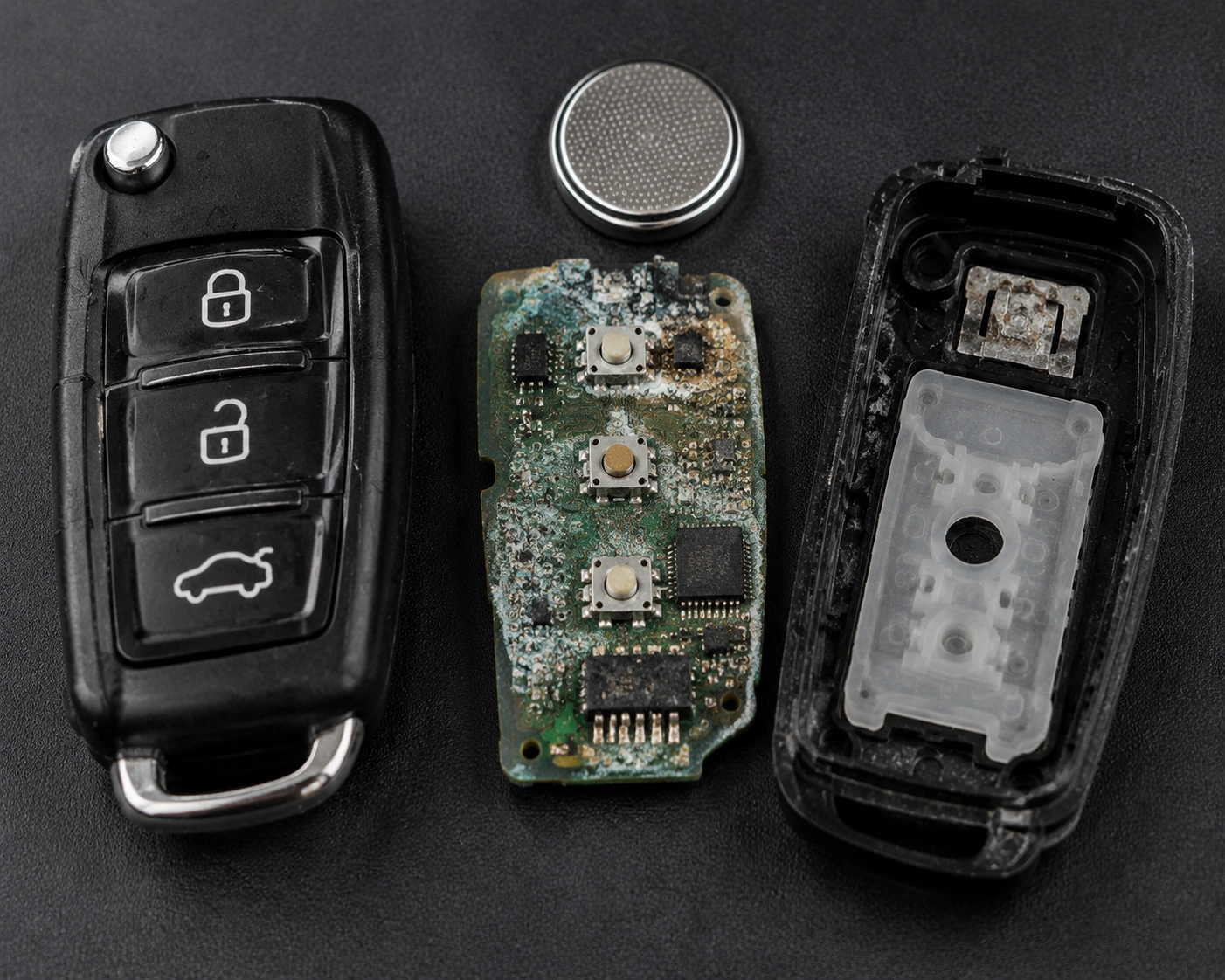
A key fob replacement may be more reliable when:
- The circuit board is badly damaged
- Several electronic components have failed
- Corrosion is widespread
- The transponder is damaged
- The board cannot hold a repair
- The key repeatedly fails after previous repairs
- A compatible replacement costs close to major board repair
Replacement should not be the automatic first answer for a worn button.
Car Keys 24’s own repair service includes damaged buttons, batteries, fobs, blades, and internal electronic faults, which supports checking repair options first.
Our guide to key repair versus replacement explains when keeping the original key makes sense.
What Affects Car Key Button Repair Cost?
There is no single price for every car key button replacement or repair.
Cost depends on:
- Vehicle make and model
- Key type
- Number of failed buttons
- Condition of the casing
- Microswitch damage
- Circuit-board damage
- Water or corrosion
- Replacement parts
- Programming or synchronisation needs
- Whether a full replacement becomes necessary
Ask for diagnosis before approving a complete replacement.
A small physical button fault can be very different from a failed circuit board.
Frequently Asked Questions
Why is only one button on my car key not working?
When other buttons work normally, the battery is less likely to be the only problem. The failed button may have a worn pad, damaged microswitch, or loose circuit-board connection.
Can key fob buttons be repaired?
Yes, many button faults can be repaired. A technician may replace a worn pad, microswitch, casing, or damaged connection when the rest of the key remains usable.
Why do I have to press my key fob button hard?
The outer rubber may be worn, the microswitch may be failing, or the casing may no longer press the switch correctly.
Will a new battery fix buttons that are not working?
It will help when weak battery power is the cause. It will not repair a broken microswitch, worn pad, damaged casing, or faulty circuit board.
Why does my key work when I squeeze the casing?
The battery or circuit board may have a loose contact. The casing may also be failing to hold the button pad and switches in the correct position.
Can a broken car key microswitch be replaced?
Often, yes. The small switch can sometimes be replaced by a technician when the surrounding circuit board remains in good condition.
Why do the remote buttons fail but the car still starts?
The remote locking system and immobiliser can use separate parts of the key. The transponder may still start the engine while the button circuit has failed.
Why have both of my car key remotes stopped working?
When both keys fail together, the fault may involve the vehicle receiver, central locking system, vehicle battery, synchronisation, or signal interference.
Does changing a key fob battery require reprogramming?
Not usually for a routine battery change, but some keys may need model-specific synchronisation. The correct process depends on the vehicle.
Should I keep pressing a faulty button harder?
No. Heavy repeated pressure can worsen damage to the rubber button, microswitch, or circuit board.
Book a Mobile Key-Fob Fault Check
If your car key buttons have become weak, stuck, intermittent, or completely unresponsive, the whole key may not need replacing.
Contact Car Keys 24 with:
- Vehicle registration
- Make and model
- Year
- Postcode
- Which buttons have failed
- Whether another key works
- Whether the key was dropped or got wet
A technician can check the battery, button pad, microswitch, casing, circuit board, and remote operation before recommending repair or replacement.
Call Car Keys 24 on 07731 505 060.


